The Danube is the second longest river in Europe after the Volga. It originates in Germany’s Black Forest and flows 1,770 miles south-east until it creates its own delta in Romania which empties into the Black Sea. Many points along the river are well known to travelers, especially those in Germany, Austria, Slovakia and Hungary, and my wife and I have cruised it many times. But we’d never gotten to the lower Danube. We’d never gone below Budapest in Hungary down along the borders between Croatia, Serbia, Bulgaria and Romania.
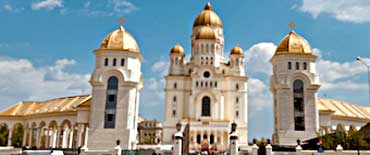
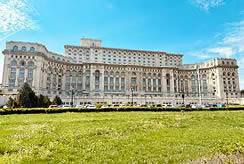
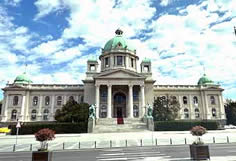
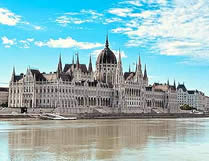
This stretch of the river called to us, however, because both of us are retired employees of the U. S. Congress in Washington, DC, where the beautiful U. S. Capitol Building has a special place in our hearts. As a result, when we travel near the capital city of a country, we always attempt to visit their capitol building, whether it is called by that name or the Parliament Building, the House of the National Assembly, or even the Palace of the Parliament. Our trip along the lower Danube gave us the chance to add three capitol buildings to our experience - the three b’s: Bucharest, Belgrade and Budapest.
| |
The capitol buildings of Bucharest, Belgrade and Budapest |
|
We will share with you Serbian and Hungarian capitals in future issues. But for now, we start where we started our trip — in Bucharest, Romania. It isn’t actually on the river, but is only 37 miles north of the Danube. Bucharest had a long history as a capital city before Romania fell under a communist dictatorship following World War II. In the 1960s, 70s and 80s, that dictator was Nicolae Ceausescu who imposed a strangling austerity on the population in order to finance grandiose plans including remaking Bucharest as a modern day Roman capital. To put it mildly, it did not go well for him. After decades in power, he was overthrown and executed by firing squad on Christmas day in 1989.
Much of Ceausescu’s creation forms the core of today’s Bucharest. His megalomanic dream saw the demolition of between 20% and 25% of historic Bucharest to make way for a mix of buildings of modern and faux-classic designs.
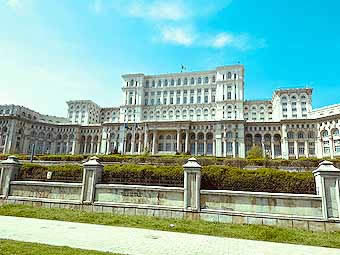
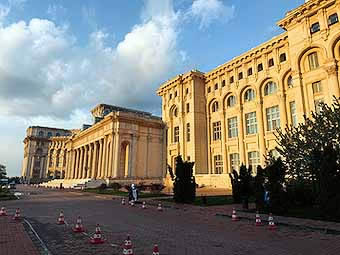
On a hill overlooking the greater urban area, his biggest (but not necessarily best) creation is the Palace of the Parliament which holds, among other things, the title of the heaviest building in the world at over four million tons. It is the world’s largest civilian administrative building. The word “civilian” in that statement is necessary because the U.S. military’s administrative building, the Pentagon, is larger. But Romania’s is so huge that its different sides seem to be separate buildings.
| |
The East and West Fronts of Bucharest’s Palace of the Parliament |
|
Designed by chief architect Anca Petrescu, and a team of around 700 other architects, the building is essentially a modernistic version of a neoclassical style with some 12 floors, eight of which are underground. It is about as long as the U.S. Capitol but nearly three times as wide — and the U.S. Capitol has only five stories. In fact, there is so much space in the Bucharest building, with more than 1,000 rooms, that over two thirds of the space is empty.
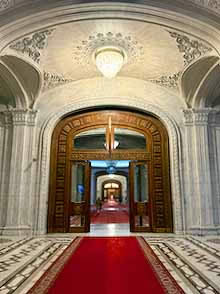
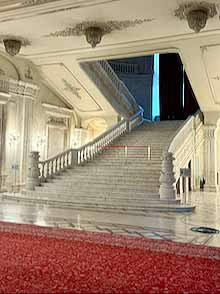
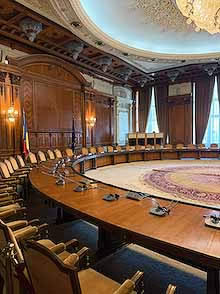
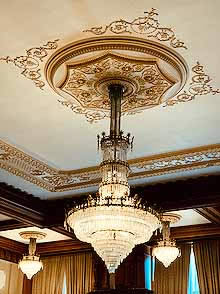
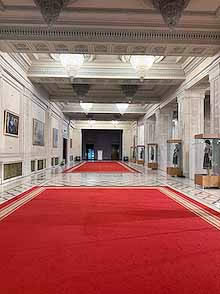
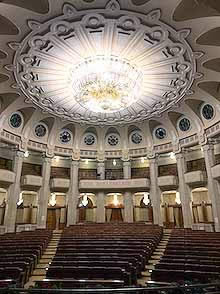
While tours don’t include the chambers of the 134-seat Senate, or the 331-seat Chamber of Deputies, they do allow visits to a few of the main halls and committee meeting rooms.
| |
The Interior of the Palace of the Parliament, Bucharest |
|
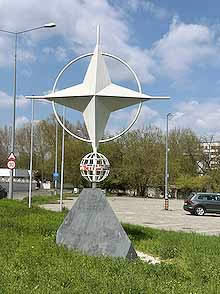
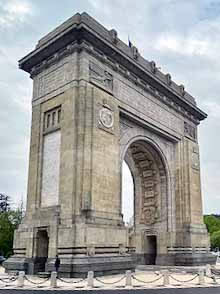
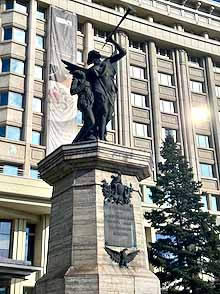
As you would expect of a capital city, monuments big and small abound. There’s a small monument to NATO — Romania has been a member of the alliance since 2004. There’s an 82 foot high Triumphal Arch built in the 1930s to commemorate the victory of World War One which resulted in the unification of the country from its previous assemblage of duchies and principalities. There are many memorial statues such as this one commemorating the battle of 1848 against the Ottoman Empire.
| |
The NATO monument, the Triumphal Arch and the memorial to the heroes of 1848 |
|
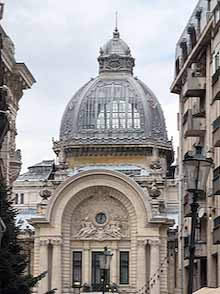
There are also many notable venerable buildings, some with their own fascinating history. The Palace of the Deposits and Consignments (or just Palatul CEC) sports one of the most beautiful metal and glass domes of the Belle Époque period. It was designed by French architect, Paul Gottereau and, having opened in 1900, withstood all the challenges of the twentieth century — two world wars, Soviet occupation, and the reign of Ceausescu.
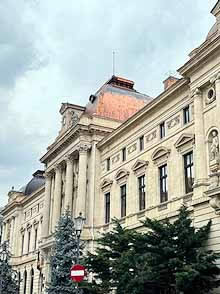
The Old Palace of the National Bank of Romania, or Palatul Vechi al Bâncii Nationale a României, is notable not only for the beauty of its exterior but for the history of its interior. It was here that the gold reserves of the country were stored before they were shipped off to Moscow for supposed safekeeping during World War One — never to be seen again.
| |
The Palatul CEC and The Old Palace of the National Bank of Romania |
|
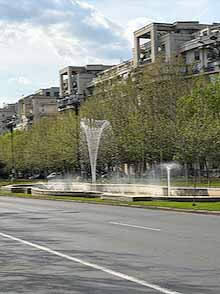
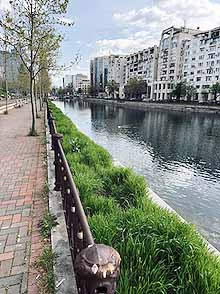
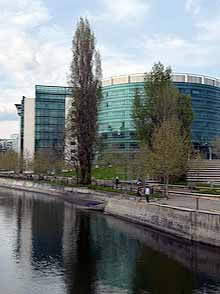
There are also wide boulevards with fountains in their center islands, paths beside the Dâmbovita, the river that runs through the city, and modern public buildings like the national library or Biblioteca Nationalä a Românei.
| |
A street-center fountain, a river-front path and the national library |
|
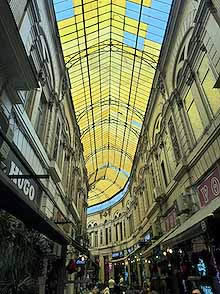
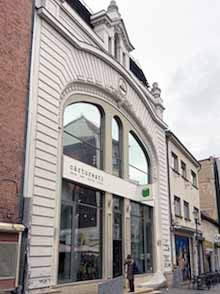
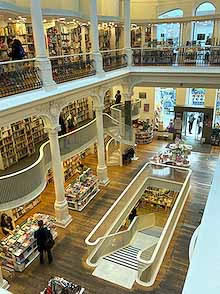
In the portion of the lipscani or old town that survived Ceausescu’s demolitions can be found a covered shopping mall (the Macca-Villacrosse Passage) and individual shops such as the Carturesti, a beautiful book store.
| |
The Macca-Villacrosse covered shopping passage and the Carturesti Book Store |
|
We wanted to check out some popular activities in the city and were delighted to find that the city hosts its own National Theater of Operetta and Musicals or Teatrul National De Operettã Si Musical which has its own theater, the Dom Dacian.
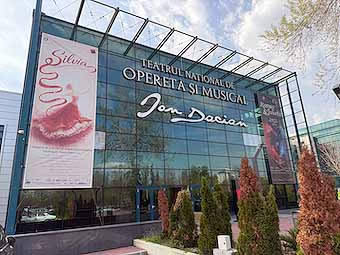
Teatrul National De Operettã Si Musical’s Dom Dacian
We attended a thoroughly enjoyable performance of an operetta crafted in 1885 using the songs of the “Waltz King,” Johann Strauss II, titled “Sânge Vienez” or “Viennese Blood.” The tunes were a delight, as you would expect, and the evening fun even for two visitors not fluent in the language. The cast was quite good, especially Gabriela Daha in the role of a model who is both one of the mistresses of a count and the fiancée of the count’s valet - it was that kind of comic operetta!
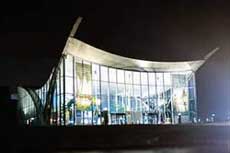
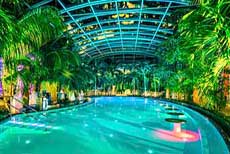
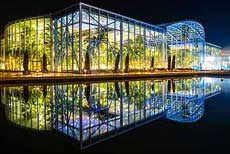
Another type of activity caught our attention as well. Outside of the city is a huge indoor/outdoor waterpark featuring warm-water pools for soaking, as well as water-slides and spa facilities, the Thermé Bucharesti. The main pool even has a bar you can wade to for a drink — we liked their iced coffee frappuccino.
They prohibit photos inside, so we asked the venue for some photos to share with you. Our visit was in the day-time but the photos they provided were evening shots and here they are.
| |
The Thermé Bucharesti water park outside of Bucharest Photos courtesy of Thermé Bucharesti |
|
On the banks of Lake Herâstâu near the Triumphal Arch is a unique kind of ethnological museum: the National Village Museum or Museul National al Satului.
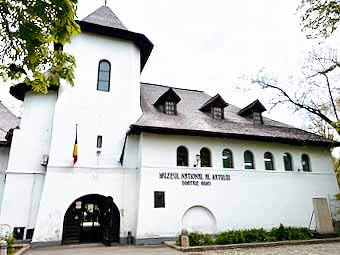
The entrance to the Museul National al Satului or National Village Museum
Founded in 1936 by a Romanian sociologist, Dimitrie Gusti, the goal of the museum was to preserve Romania’s rural life before it all disappeared under the onslaught of modern development and urbanization. Today the outdoor museum has 40 houses, 165 outbuildings and three churches which represent the rural life in many different regions of the country.
| |
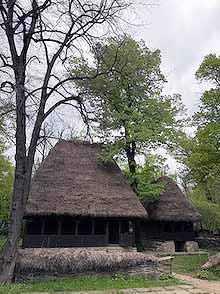
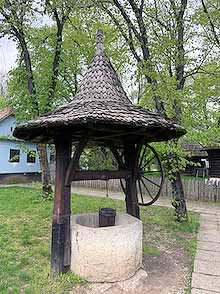
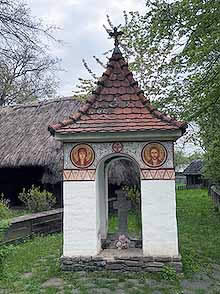
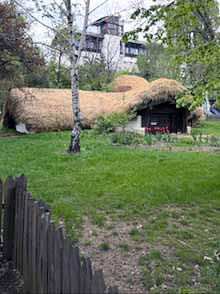
A thatched house, a covered well and a sheltered troitâ at the National Village Museum |
|
The houses displayed over the 15 acres of the museum are of a variety of construction styles. One, a thatched house that once belonged to a peasant in the Transylvania region, dates to 1815. Nearby are a covered well and a classic example of a Romanian sheltered stone cross or troitâ. Such wayside crosses served not only the religious significance of the cross, they identified key locations as they were placed near villages, bridges and junctures.
| |
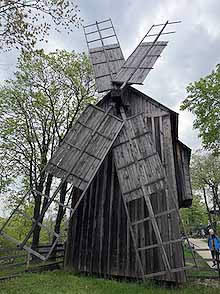
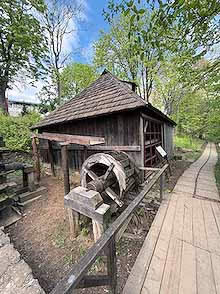
A half-buried house, a windmill and a seed press |
|
There is a bordeiul, or half-buried house from the Castranova district of the flat Romanian plain along the Danube. The design had two distinct advantages: the building wasn’t much impacted by the high winds prevalent on the plain, and it would be easily camouflaged to avoid detection when the area was invaded by the Ottoman Empire that made frequent incursions across the Danube. Not far from the bordeiul are a nineteenth century windmill for grinding grain which follows the design and mechanism developed in the sixteenth century, and a fulling machine that used eighteenth century technology to press the oil from seeds before the remaining paste would be fed to livestock.
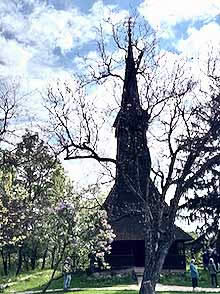
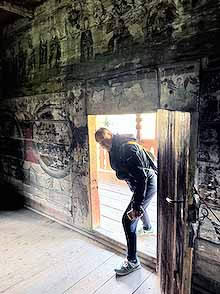
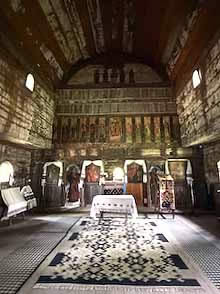
One of the most interesting buildings is the Dragomiresti Wooden Church built in 1722 in the Transylvania area that is part of Romania today. It is a Greek-Catholic distinguished from a Romanian Orthodox church. What amazed us was the fact that this structure was constructed entirely without nails. In 1936 it was disassembled and shipped here to be reassembled with its interior intact. The entrance door is quite small and unimpressive but it opens into a beautiful interior.
| |
The Dragomiresti Wooden Church |
|
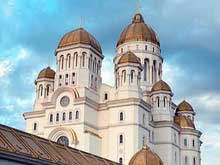
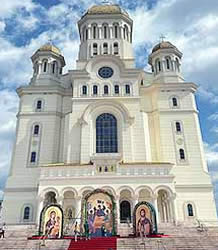
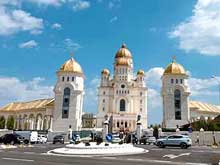
One more thing that Bucharest, Belgrade and Budapest have in common — they all have major cathedrals. Bucharest’s People’s Salvation Cathedral (Catedrala Mântuirii Neamului) is the newest. Indeed, it is still under construction, although it was briefly opened last year. By the time we visited, the interior had been closed again to allow for the completion of what will be the largest mosaic collection in the world measuring over a quarter of a million square feet. Better known as just the National Cathedral it is the tallest and by volume the largest Eastern Orthodox church building in the world. It is the patriarchal cathedral of the Romanian Orthodox Church. Construction began in 2010 and the cathedral was consecrated in 2018.
| |
Three views of the National Cathedral of the Romanian Orthodox Church |
|
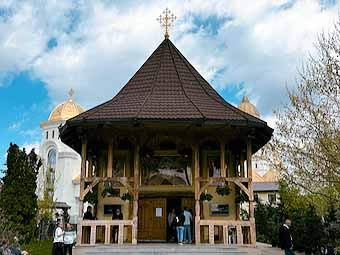
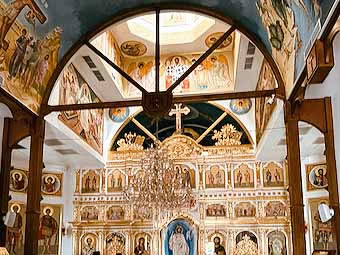
While we couldn’t view the interior of the main cathedral, there was a small chapel open on the premises that was built to accommodate parishioners of the neighborhood during construction. It had an interior of note. Small, but beautiful.
| |
The Chapel of the National Salvation Cathedral - exterior and interior |
|
After five days in Bucharest, it was time to leave Romania and continue our cruise up the Danube river. Next stop? Bulgaria and Serbia: and another capital: Belgrade. But that is Part 2 — join us next time.
ABOUT THE AUTHOR
| |
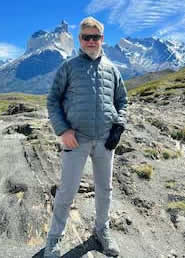
Brad Hathaway retired to live with his wife on a houseboat in Sausalito, California, after nearly two decades covering Theater in Washington, DC, on Broadway, and nationwide. He is both former vice chair of the American Theatre Critics Association and editor of that association’s newsletter.
He's standing here before the Peaks of Torres del Paine. |
|
 |
|
|